
PSPA – Photoluminescent Safety Products Association congregates the most important companies with the best know how, “the State of the Art” on the production side and the most relevant experience on specifying and installation of Photoluminescent Safety Products and Services in the Fire, Safety & Security areas.
PSPA members participate actively at national and international Standards Organizations, namely ISO and CEN.
With the objective of helping prescribers – architects, engineers, Health and Safety managers, fire brigades and the market in general – PSPA update the Classifications of Photoluminescent Products and present recommendations of the best practices and references in different areas.
PSPA Photoluminescent Classification:

Introduction
Several incidents and disasters – terrorist attacks, fire, and natural disasters – which occurred at the start of this century demonstrate the evidential need and benefits of photoluminescent safety signage and safety systems in the preservation of life in emergency situations.
This need is not just confined to buildings, instinctively the first and most commonly considered environment, for where much evidence is already available and well known – but also in many other sectors and environments such as construction sites, tunnels, mines and in multiple transportation sectors such as maritime, off-shore, aviation, and public transport. Furthermore, recent studies of natural disasters (i.e. forest fires and tsunamis) have also demonstrated the clear benefits of evacuation signage within these affected areas.
Ongoing technological advancements, both with the manufacturing of photoluminescent pigments and the ongoing development of photoluminescent safety products, provide new and exciting solutions which, if prescribed and applied correctly, can make life saving differences.
To guarantee the minimum technical characteristics, operational performance and appropriate functionality, standards have been developed worldwide by national and international standard and certification organizations, the majority of these in conjunction with the PSPA & it’s members. These methodologies have been created to test the product manufacturing process; a standardized laboratory-based test to establish the classification of the unprinted photoluminescent and to ensure the best performance a further on-site test to ensure functionality, once in situ.
The PSPA (Photoluminescent Safety Products Association) was formed in 1991 to raise awareness of photoluminescent products and their applications as well as promote integrity in the worldwide photoluminescent safety products market. With these objectives in mind, the PSPA present the globally recognized “PSPA Photoluminescent Classification” found on the first page of this document and recommends where possible, adhering to the best practice procedures in accordance with ISO standards:
1. ISO 17398 – Safety colours and safety signs — Classification, performance and durability of safety signs
Photoluminescent safety signs used at the locations of Fire and Alarm Equipment, Personal Protective Equipment (PPE), Dangerous and Hazardous products/areas and Evacuation Directional Signage shall be a minimum of Class C: Minimum lumincance (mcd/m2) at 2 minutes: 690; at 10 minutes: 140; at 30 minutes 45; at 60 minutes 20.
2. ISO 16069 – Graphical symbols — Safety signs — Safety way guidance systems (SWGS)
Photoluminescent safety products and signage used on Low Location Signage (LLL) installations shall comply with a minimum of 140/20 mcd/sqm and 1800 minutes of period of light decay (laboratory test) and 30/7/5 mcd/sqm (site test).
3. ISO 15370 – Ships and marine technology — Low-location lighting (LLL) on passenger ships
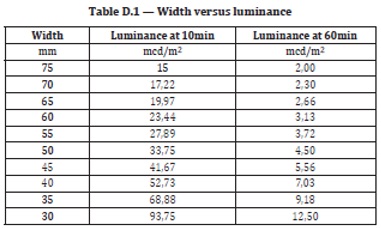
Low Location Signage (LLL) on Ships and Marine Technology shall comply with performance indicate don ISO 15370, specially with formula where:
L’ = L (75/d’)2
L’ is the increased value of luminance;
L is the minimum luminance in accordance with 4.2.1.;
d’s is the reduced width of the PL strip in millimeters
4. ISO 22578 – Graphical symbols — Safety colours and safety signs — Natural disaster safety way guidance system
Natural disaster safety way guidance system with the use of Photoluminescent safety signage shall comply with performance values shown on table 3 of ISO 22578 (see below) when in situ, please refer to the specific charging conditions of your photoluminescent product.

5. ISO 16069 is the recommended standard for laboratory tests and on-site tests for safety signage and products appropriate for Low Location Level installations.
For further assistance and advice on selecting the best product for your individual application, please do not hesitate to contact PSPA directly at office@thepspa.com